






Blinq is one of the best-known digital business card apps, and its Business plan covers a lot: team cards, admin-controlled email signatures, card templates, CRM sync and event lead capture. But the per-card price is only part of what a team pays. NFC cards are bought separately, enforced SSO and SCIM provisioning sit in the Enterprise plan, and the pricing page lists a per-lead fee for lead capture and enrichment. If you are rolling out cards to a sales team, a whole department or several offices, those details decide what the platform really costs.
This guide compares eight Blinq alternatives for teams on the things buyers ask about: published team pricing, whether an NFC card is included, admin and brand controls, CRM integrations, SSO and lead capture fees. Every price comes from the vendor's own pricing page and is shown as of November 2026. We make Tapni, a digital business card and lead capture platform for teams that is part of Tapstack, so we have tried to be especially careful to describe every other vendor fairly. Plans change often, so check the current terms before you sign.
The short version
- Tapni: one price per user per year with a standard NFC card included for every user, native CRM integrations and volume tiers that drop the price as your team grows.
- HiHello: strong on brand templates and email signatures, with Salesforce, HubSpot and Microsoft Dynamics on the Business plan.
- Wave Connect: a low per-user price with a 3-user minimum, plus pay-as-you-go credits for lead enrichment at events.
- Uniqode: a good fit if you already use it for QR codes, but Salesforce and HubSpot need the Business+ plan.
- Mobilo: the lowest published software price for a 10-person team in this list, with cards bought separately.
- Dot: team plans that include a device for every member, priced per member.
- Popl: built around event lead capture, with pricing by quote only.
- V1CE: pay once for the card, with free software and an optional paid AI plan.
Why teams look for Blinq alternatives
Blinq does a lot well. Its Business plan includes digital business cards for the whole team, admin-controlled email signatures, custom card templates with brand control, automated card provisioning, native CRM integrations and event lead capture with badge scanning. There is a 30-day free trial, and admins and team members who don't have a card assigned aren't billed.
As of November 2026, Blinq Business costs $4.99 per card per month billed annually, or $6.99 per card billed monthly, with a minimum of five cards. The reasons teams compare alternatives are usually these:
- Hardware is extra. NFC cards are sold separately in Blinq's shop, so a team that wants tap-to-share cards pays for software and hardware.
- Lead enrichment can be metered. With monthly billing selected, Blinq's pricing page lists $9.99 per lead captured and enriched under the Business plan's lead capture and enrichment features. For a team that runs several trade shows a year, that can matter more than the seat price, so ask how enrichment is billed on the plan you choose.
- Identity features sit in Enterprise. Enforced SSO, SCIM user provisioning and subteam admin access are part of Blinq Enterprise, which is priced on request.
- Billing is per card. On the annual plan you pay upfront for the cards you start with, and cards you add later are charged pro rata.
None of these is a flaw. They are pricing choices, and whether they suit you depends on your team size, how many events you run and what your IT team needs. If you are weighing Blinq against one specific vendor, our Blinq vs HiHello comparison goes into more detail.
Blinq alternatives at a glance
Published list prices for the main team plan of each vendor, as of November 2026. "Annual" means billed annually.
| Platform | Team plan list price | NFC card in the plan | CRM on that plan | SSO and SCIM |
|---|---|---|---|---|
| Blinq (baseline) | $4.99 per card per month, annual; minimum 5 cards | No, sold separately | Native CRM integrations | Enterprise |
| Tapni | $59.90 per user per year for 1–10 users, lower from 11 users | Yes, a standard NFC card per user | HubSpot, Salesforce, Pipedrive, Microsoft Dynamics, Zoho, Odoo, Attio | Enterprise |
| HiHello | $5 per user per month, annual; minimum 5 users | Not listed in the plan | Salesforce, HubSpot, Microsoft Dynamics | Google and Microsoft SSO on Business; SAML SSO and SCIM on Enterprise |
| Wave Connect | $5 per user per month, annual; minimum 3 users | No, sold separately | Native CRM sync | Enterprise |
| Uniqode | $6 per user per month, annual only | Not listed in the plan | Pipedrive on Team; Salesforce and HubSpot on Business+ | SAML SSO on Business+ |
| Mobilo | $4 per card per month, annual, plus the card | Bought with the plan; digital wallet card from $0 | CRM integrations listed on Teams | Enterprise SSO listed; ask sales which tier |
| Dot | $8 per member per month, annual (1–15 members) | Yes, a standard device per member | CRM integrations on the $15 Growth plan | Not listed |
| Popl | Pricing on request | Ask sales | CRM and marketing automation integrations | Ask sales |
| V1CE | Cards from US$81 each, one-time; free software | You buy the card | HubSpot, Salesforce, Zapier and Make | Not listed |
The 8 best Blinq alternatives for teams
1. Tapni
Best for: teams that want cards, profiles, lead capture and CRM sync in one price per person.
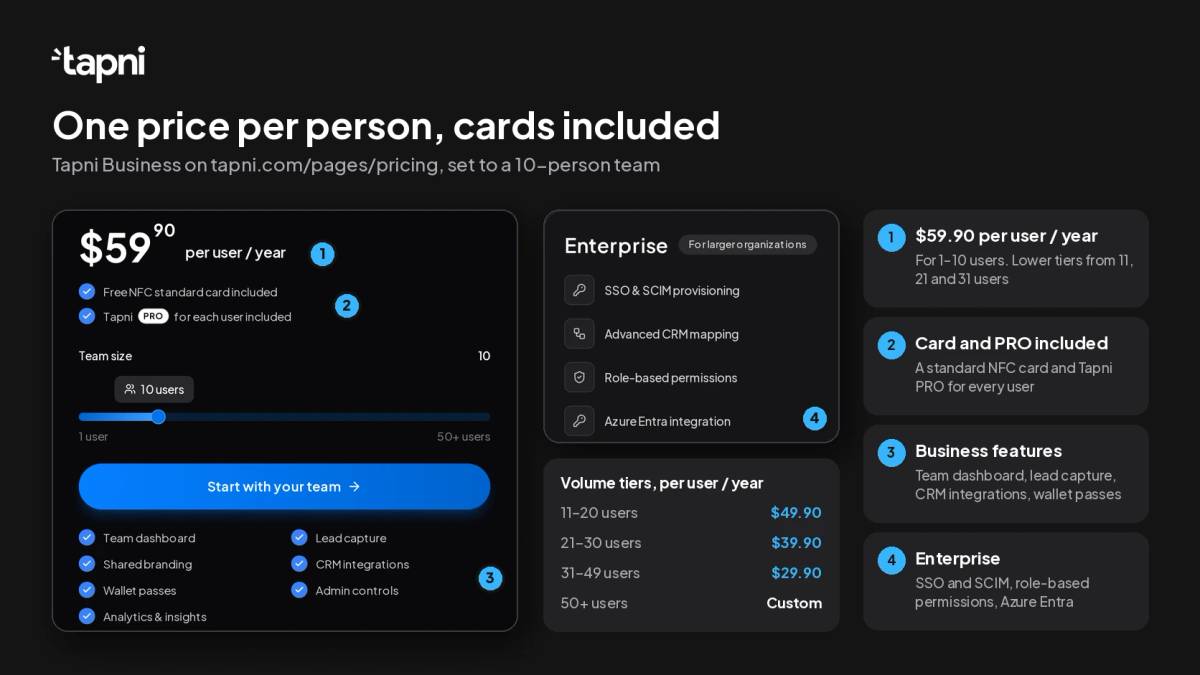
Tapni Business is priced per user per year, and the price drops as the team grows: $59.90 per user per year for 1–10 users, $49.90 for 11–20 users, $39.90 for 21–30 users and $29.90 for 31–49 users. Teams of 50 or more get custom pricing. Every user gets a free standard NFC card and Tapni PRO, so a 10-person team pays $599 a year with the cards included.
What teams get:
- NFC cards and branded profiles. Cards in PVC, bamboo or metal can be printed with your design and each person's name, and profiles can live on your own domain, such as yourcompany.link/julia. We print and ship the cards, and onboarding support is free.
- Brand control. Logos, colours and layouts live in templates, and admins decide which fields people can edit.
- Lead capture. Two-way contact exchange from the profile, an AI business card scanner in the app, and notes, tags and follow-up reminders.
- CRM sync. Native integrations with HubSpot, Salesforce, Pipedrive, Microsoft Dynamics, Zoho, Odoo and Attio, plus Zapier, SFTP export and a public API. Our guide to digital business card CRM integration shows how the sync works.
- Team dashboard. Add people in bulk, update profiles centrally and deactivate a card in one click when someone leaves.
- Analytics. See your most active employees and each person's profile views by NFC tap, QR scan and link, with date filters and CSV/XLSX/PDF export.
- Wallet passes, email signatures and virtual backgrounds from the same profile data.
Worth knowing: SSO and SCIM provisioning, advanced CRM mapping, role-based permissions and the Azure Entra integration are listed under Tapni Enterprise, which is quoted by our sales team. The included card is the standard NFC card, so ask about custom-designed, bamboo or metal cards when you request a quote.
2. HiHello
Best for: brand and marketing teams that want card and email signature templates managed in one place.
HiHello Business costs $5 per user per month billed yearly ($60 per user per year) or $6 billed monthly, for teams of 5 to 100 users, with a five-user minimum. The per-user price drops at 26 and again at 51 users, and there is a 14-day free trial. Teams of 100 or more move to HiHello Enterprise, priced on request.
The Business plan includes 10 card templates and 10 signature templates, four cards per user pooled across the team, email signatures deployed to Gmail and Outlook, a lead capture form and event lead capture, and integrations with Salesforce, HubSpot and Microsoft Dynamics. It also includes 50 paper card or badge scans per user per month, pooled across the team, plus Google and Microsoft SSO with directory sync.
Worth knowing: the Business plan doesn't list a physical NFC card. SAML SSO and SCIM for providers such as Okta are part of Enterprise.
3. Wave Connect
Best for: small teams that want a low entry price and only pay for lead enrichment when they use it.
Wave Connect Teams costs $5 per user per month billed annually, or $7 billed monthly, with a minimum of three users and a 14-day trial. Teams includes an admin platform, bulk profile editing, custom templates, locked user content, admin email signatures, a shared contacts dashboard and team analytics, on top of the Pro plan's native CRM sync. SAML SSO, SCIM provisioning and custom domains are part of Enterprise.
Event lead capture is priced separately. Pay-as-you-go credits cost $2.50 each, with 10 free credits to start. A lead form, business card or LinkedIn scan uses one credit and an event badge uses four, and no credit is used if Wave can't find the person's details. Annual event plans with volume credit pricing are quoted.
Worth knowing: NFC cards are sold separately in Wave's shop, and badge-heavy event teams should model their credit use before comparing totals.
4. Uniqode
Best for: marketing teams that already run QR code campaigns on Uniqode and want cards in the same account.
According to Uniqode's own plans and pricing page, the Team plan for its digital business cards costs $6 per user per month, billed annually, with no monthly option and a minimum of one user. Team includes unlimited lead generation and card analytics, bulk card creation, card template management, multilingual cards, 20 AI contact enrichment credits per month, API access, role-based access control and transfer of card ownership. Integrations on Team are Google Analytics, Google Ads, Meta Pixel, Google Workspace and Pipedrive.
Worth knowing: Salesforce, HubSpot and Microsoft Entra ID integrations, SAML SSO and custom domains are on Business+, which has custom pricing and a 50-user minimum. Uniqode's plan pages don't list a physical NFC card.
5. Mobilo
Best for: cost-conscious teams that are happy to buy cards and software separately.
Mobilo's Teams plan costs $4 per month per card, billed annually, and you choose the card with it: a digital wallet card from $0, or a custom-designed NFC card, wood card or metal card at an extra one-off price. Teams includes unlimited team members, the ability to control, lock and override data fields, team analytics and CRM integrations. Mobilo also lists a Business tier at $5 per month billed annually, sold through its sales team; its feature list includes options such as HR directory sync, enterprise SSO and custom domains, so confirm with Mobilo which of them your tier covers.
Worth knowing: card prices on Mobilo's pricing page were shown at a promotional discount in November 2026, so confirm the hardware price when you get a quote.
6. Dot
Best for: teams that want a device for every member bundled into a per-member price.
Dot's team plans are priced per member per month, billed annually. For teams of 1–15 members, Essential costs $8 per member per month and includes a complimentary standard device for every member, profile templates, profile content restrictions and team management. Growth costs $15 per member per month and adds complimentary custom devices, the advanced dot.Profile+, an AI paper business card scanner, member contact management, white-label profiles, team networking insights and CRM integrations.
Worth knowing: CRM integrations are on Growth, not Essential. Larger teams pick a different team-size band on Dot's pricing page.
7. Popl
Best for: companies whose main goal is event lead capture and enrichment rather than everyday card sharing.
Popl positions itself as an event lead capture platform. Its pricing page lists a badge scanner, contact and company data enrichment, event campaigns with qualifying questions, self-serve CRM and calendar integrations, a dedicated customer success manager and digital business cards for the team. Popl doesn't publish prices: plans are quoted after a call. Popl says its pricing covers unlimited users, events and leads, with no per-seat charges and no credit system.
Worth knowing: because pricing is on request, you can only compare Popl on total cost once you have a quote. Teams that mostly need branded cards and profiles may be paying for event features they won't use.
8. V1CE
Best for: small teams that would rather pay once for premium cards than pay a monthly fee.
V1CE sells the card as a one-time purchase and includes its software free. On its teams page, cards cost US$81 each for the printed Original, US$112 for Bamboo and US$149 for Metal, with team discounts from 10% at 5 people to 30% at 50 people. V1CE can set up all the cards and profiles for US$199, or you can add each person yourself for free. The free software covers the digital page, two-way lead capture and a built-in CRM that syncs with HubSpot, Salesforce, Zapier and Make.
Worth knowing: V1CE's paid ClientCapture OS plan costs US$65 per user per month and adds its AI assistants, unlimited AI credits and your own domain. It is priced per user, so check which team features you need before you plan a rollout.
What a 10-person team pays in year one
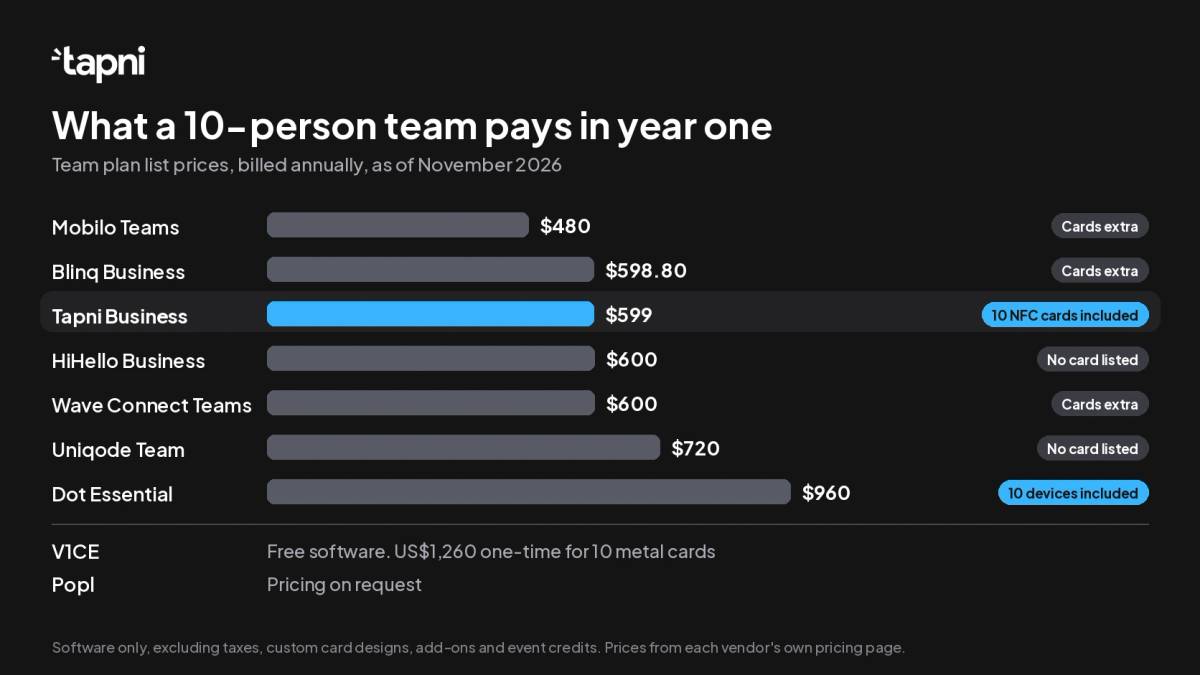
Per-seat prices are hard to compare when one vendor includes cards and another doesn't. Here is what each published plan costs for a 10-person team in the first year at list price, billed annually, as of November 2026. Taxes, custom card designs, add-ons and event credits are not included.
| Platform and plan | Software, 10 users, year one | Physical NFC cards |
|---|---|---|
| Mobilo Teams | $480 | Extra (digital wallet card from $0) |
| Blinq Business | $598.80 | Extra |
| Tapni Business | $599 | Included, 10 standard cards |
| HiHello Business | $600 | Not listed |
| Wave Connect Teams | $600 | Extra |
| Uniqode Team | $720 | Not listed |
| Dot Essential | $960 | Included, 10 standard devices |
| V1CE | $0 (free software) | US$1,260 one-time for 10 metal cards |
| Popl | Pricing on request | Ask sales |
At ten users, most per-seat plans land close together. The differences come from three places: whether a physical card is included, which plan your CRM and SSO requirements push you into, and how lead capture at events is charged. For a fuller model at 5, 25, 50 and 100 users, see our guide to digital business card pricing for teams.
How to choose the right Blinq alternative
Start with your requirements, not the seat price. These questions narrow the list quickly.
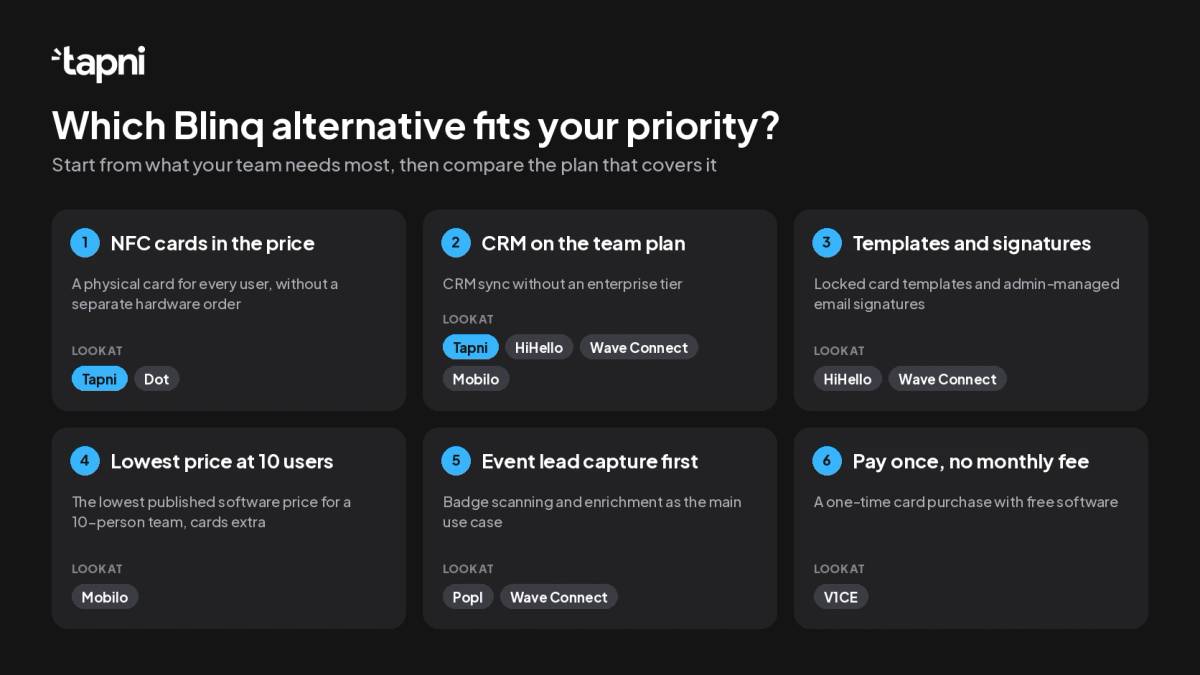
- Which CRM do you use, and which plan includes it? Salesforce and HubSpot are on different plans at different vendors. Check the plan you would actually buy, not the top tier.
- Do you need physical NFC cards? If everyone gets a card, compare software plus hardware. A plan with cards included can be cheaper overall than a lower seat price.
- How many events do you run? Per-lead and per-credit enrichment fees scale with your busiest month, not your average one.
- What does IT require? If SSO, SCIM or directory sync is mandatory, find out which tier includes it and what that tier costs for your headcount.
- How much brand control do you need? Ask which fields employees can edit, and whether templates update every card when you change them.
- What happens when someone leaves? Check how cards are deactivated and reassigned, and where that person's leads end up. Our guide on offboarding an employee's digital business card covers what to look for.
Then run a short pilot with a handful of people: share a card by NFC and QR code on different phones, capture a lead at a real meeting, check that it reaches the right record in your CRM, and deactivate a test user.
How to switch from Blinq without losing contacts
Switching platforms is mostly a data and timing exercise. Plan it so nobody is left without a working card.
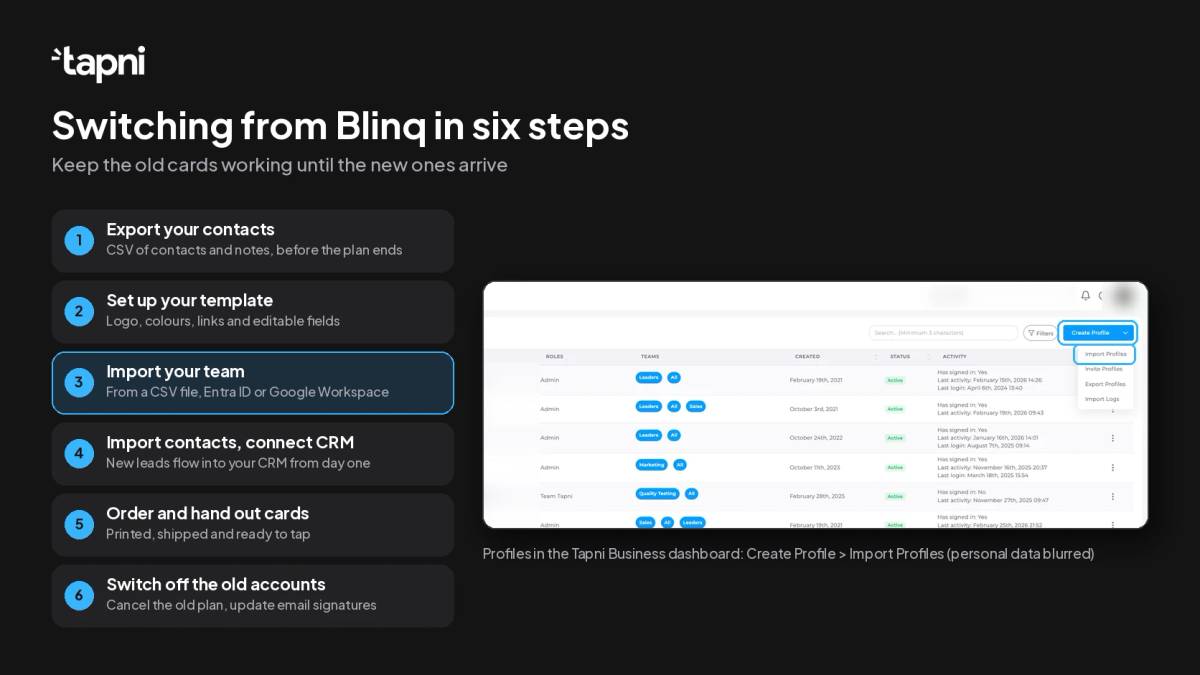
- Export your contacts first. Blinq Pro and Business include contact and note export via CSV. Export before your subscription ends, and keep the file as a backup.
- Set up your template. Recreate your brand on the new platform: logo, colours, company links and which fields people can edit.
- Import your team. In Tapni, you can add people from a CSV file, Microsoft Entra ID or Google Workspace, and every profile is pre-filled. Which directory options you use depends on your plan.
- Import your contacts and connect your CRM. Bring the exported contacts into the new platform's contact list, then connect your CRM so new leads flow in from day one.
- Order and hand out the cards. With Tapni, we print and ship the cards ready to tap. Keep the old cards working until the new ones arrive.
- Switch off the old accounts. Once everyone is live, cancel the old plan and remove the old card links from email signatures.
For the people side of a rollout, from pilot group to adoption, read our guide to rolling out digital business cards for teams.
FAQ
What is the best Blinq alternative for teams?
It depends on what you need most. If you want NFC cards included in a per-user price with native CRM sync, look at Tapni or Dot. If brand and email signature templates matter most, look at HiHello. If event lead capture is the main goal, Popl and Wave Connect focus on it. Shortlist two or three and run a pilot.
How much does Blinq cost for a team?
As of November 2026, Blinq Business costs $4.99 per card per month billed annually or $6.99 billed monthly, with a minimum of five cards. With monthly billing, the pricing page lists $9.99 per lead captured and enriched, and NFC cards are sold separately. Enterprise pricing is on request.
Which Blinq alternatives include an NFC card?
Among the plans in this guide, Tapni Business includes a standard NFC card for every user, and Dot's team plans include a device for every member. Mobilo and V1CE sell the card with the plan or as a one-time purchase. Blinq and Wave Connect sell NFC cards separately.
Can we keep our contacts if we leave Blinq?
Yes. Export your contacts and notes as a CSV file before your subscription ends, then import them into the new platform. If your leads already sync to your CRM, they stay there whichever card platform you use.
Do Blinq alternatives support SSO?
Most do, but usually on a higher tier. Blinq, Tapni, Wave Connect and HiHello list SSO and SCIM provisioning on their enterprise plans, and Uniqode lists SAML SSO on Business+. HiHello Business also includes Google and Microsoft SSO with directory sync.
Find the right fit for your team
The best Blinq alternative is the one whose plan includes what your team actually uses: the cards, the CRM, the identity features and the lead capture, at a price you can predict. If you want to see how Tapni handles cards, profiles, leads and CRM sync for a team like yours, visit Tapni for Business, compare Tapni vs Blinq feature by feature, or book a 30-minute demo with our team.


