






Ask three digital business card vendors what they cost for a team and you will get three different kinds of answer: a price per user per year, a price per card per month, or "book a demo". Then the extras start. Physical NFC cards, lead enrichment, badge scanning credits, SSO and SCIM, and a higher price if you pay monthly. Two plans with the same headline price can end up hundreds of dollars apart by the end of the year.
This guide is for the people who sign off on that budget: sales and marketing leaders, office and HR managers, IT and procurement. It explains the pricing models you will meet, shows the per-user cost at 5, 25, 50 and 100 users using prices published on vendors' own pricing pages as of November 2026, lists the hidden costs worth checking, and ends with a total cost of ownership worksheet you can copy for your 2027 budget. The examples use Tapni, a digital business card and lead capture platform for teams that is part of Tapstack.
If you are still choosing between platforms on features, start with our comparison of the best digital business cards for teams. This article focuses on cost.
The short version
- Most team plans are priced per user (or per card) per year. At 25 users, published list prices for team plans range from about $1,000 to $1,500 a year, before cards and add-ons.
- Volume tiers matter more than the headline price. Some vendors drop the per-user price as the team grows, others keep a flat rate until you reach an enterprise quote.
- The real differences are in the extras: whether a physical NFC card is included, whether lead enrichment is charged per lead or per credit, and whether SSO and SCIM sit in a higher tier.
- Paying monthly usually costs 20–40% more than paying annually on the plans we checked.
- Budget on total cost of ownership, not the price per seat. The worksheet below covers every line item.
What you actually pay for in a team plan
A digital business card plan for a company usually bundles four things. Knowing which ones are in the seat price, and which are billed separately, is most of the work in comparing quotes.
- The digital card and profile. Every employee gets a mobile profile they can share by NFC tap, QR code or link. This is the core of every plan.
- Admin and brand control. A dashboard to add and remove people, templates that keep every card on brand, and locked fields. This is usually what separates a team plan from an individual one.
- Lead capture and CRM sync. Contact exchange forms, paper card or badge scanning, enrichment, and native integrations with CRMs such as HubSpot, Salesforce or Pipedrive. This is where pricing varies most.
- Physical cards. An NFC card for each employee, from standard PVC to metal. Some vendors include one per user, others sell them separately or leave you to buy your own.
Security and IT features (single sign-on, SCIM user provisioning, role-based permissions) often sit in an enterprise tier with custom pricing, which matters if your IT team requires them.
The four pricing models you will meet
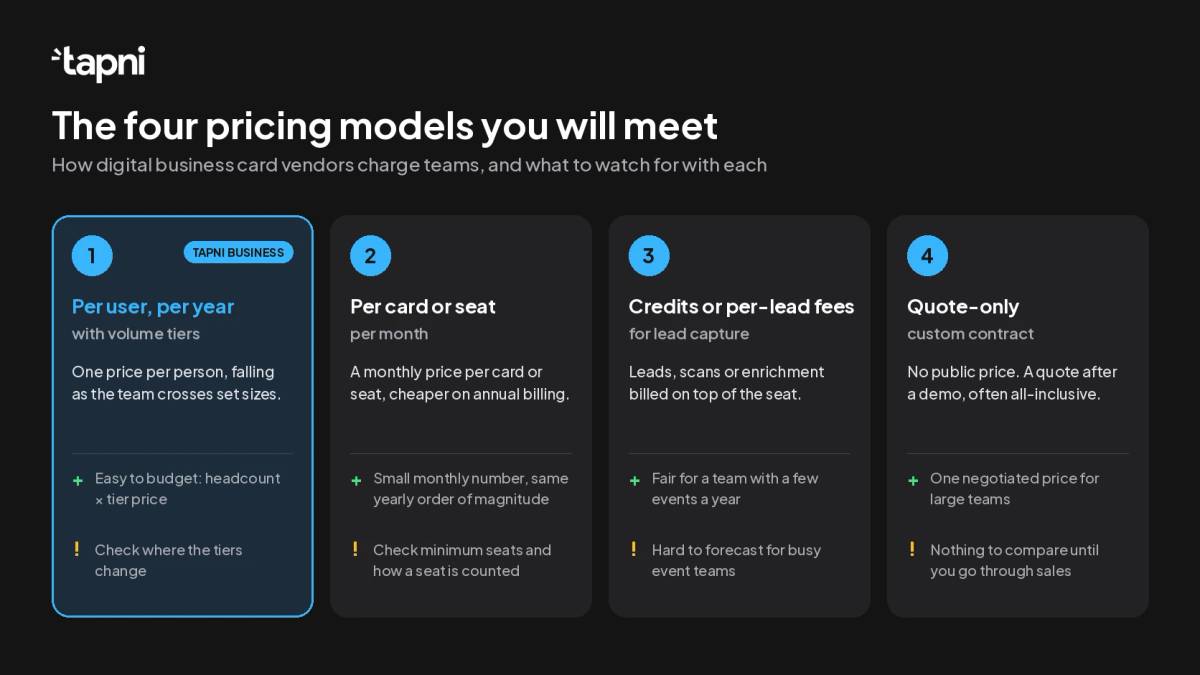
Vendors package these features in different ways. Most quotes fall into one of four models, and some combine two.
1. Per user, per year, with volume tiers
You pay a fixed price for each person on the plan, and the price per person falls as the team crosses set thresholds. This is the easiest model to budget: multiply your headcount by the tier price. Tapni Business works this way, with the price per user dropping at 11, 21 and 31 users.
2. Per card or per seat, per month
The price is quoted per card or per seat per month, usually with a cheaper rate when billed annually and a minimum number of seats. It looks small on a pricing page ("$5 a month") but adds up to the same order of magnitude as a yearly seat price. Check how a seat is counted: per user, per card or per active profile, and whether people who don't have a card are billed.
3. Credits or per-lead fees for lead capture
Some vendors charge for lead capture and enrichment separately from the seat. You buy credits, or pay a fee per lead captured and enriched, and scanning an event badge can cost more than scanning a paper card. This model can be fair for a team that attends two events a year. It gets expensive and hard to forecast for a team that exhibits every month.
4. Quote-only or all-inclusive contracts
Some platforms don't publish prices at all and quote after a demo, often for unlimited users, events or leads. Enterprise tiers almost always work this way. You get one negotiated price, but you can't compare it with anything until you have gone through a sales process.
Per-user costs compared at 5, 25, 50 and 100 users
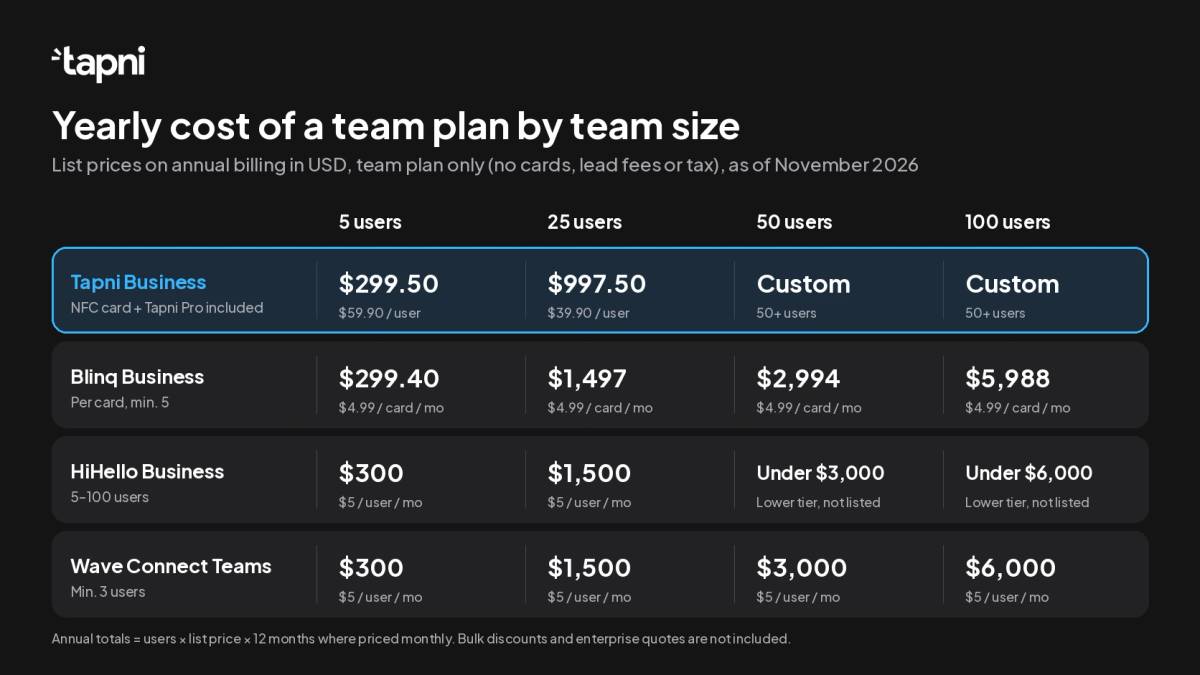
The table below uses list prices from each vendor's own pricing page as of November 2026, in US dollars, on annual billing. It covers the team plan only: no physical cards, no lead enrichment fees and no taxes. Where a vendor quotes a custom price or doesn't publish a tier, we say so rather than guess.
| Team plan (annual billing) | 5 users | 25 users | 50 users | 100 users |
|---|---|---|---|---|
| Tapni Business (NFC card and Tapni Pro included per user) | $59.90 per user $299.50 a year |
$39.90 per user $997.50 a year |
Custom pricing (50+ users) | Custom pricing (50+ users) |
| Blinq Business ($4.99 per card per month, minimum 5 cards) | $299.40 a year | $1,497 a year | $2,994 a year | $5,988 a year |
| HiHello Business ($5 per user per month, 5–100 users) | $300 a year | $1,500 a year | Under $3,000 (lower tier from 26 users, price not published) | Under $6,000 (lower tier from 51 users, price not published) |
| Wave Connect Teams ($5 per user per month, minimum 3 users) | $300 a year | $1,500 a year | $3,000 a year | $6,000 a year |
Three things stand out. At five users, the published team plans cost almost exactly the same, around $300 a year. From 11 users onwards, volume tiers start to make a difference: at 25 users, Tapni's tier price is $39.90 per user, about a third less than a flat $60 a year. And at 50 to 100 users, most buyers will be talking to sales anyway, because that is where custom pricing, bulk discounts and enterprise tiers begin.
Some vendors list bulk discounts without publishing them, and HiHello says its per-user price drops at 26 and 51 users without listing the new rate. Ask for those numbers in writing before you compare. Popl, which now positions itself mainly as an event lead capture platform, doesn't publish prices: its pricing page asks you to book a demo for a quote and says its plans have no per-seat or credit fees.
How Tapni Business pricing works
Tapni Business is priced per user per year. As of November 2026, the Tapni pricing page lists these tiers:
| Team size | Price per user per year |
|---|---|
| 1–10 users | $59.90 |
| 11–20 users | $49.90 |
| 21–30 users | $39.90 |
| 31–49 users | $29.90 |
| 50+ users | Custom pricing, talk to sales |
Every user gets a free standard NFC card and Tapni Pro. The plan includes the team dashboard, lead capture, shared branding, CRM integrations, wallet passes, admin controls, and analytics and insights. Volume discounts apply automatically as the team grows, and free onboarding support is included. For larger organisations, the Enterprise plan adds SSO and SCIM provisioning, advanced CRM mapping, role-based permissions and Azure Entra integration.
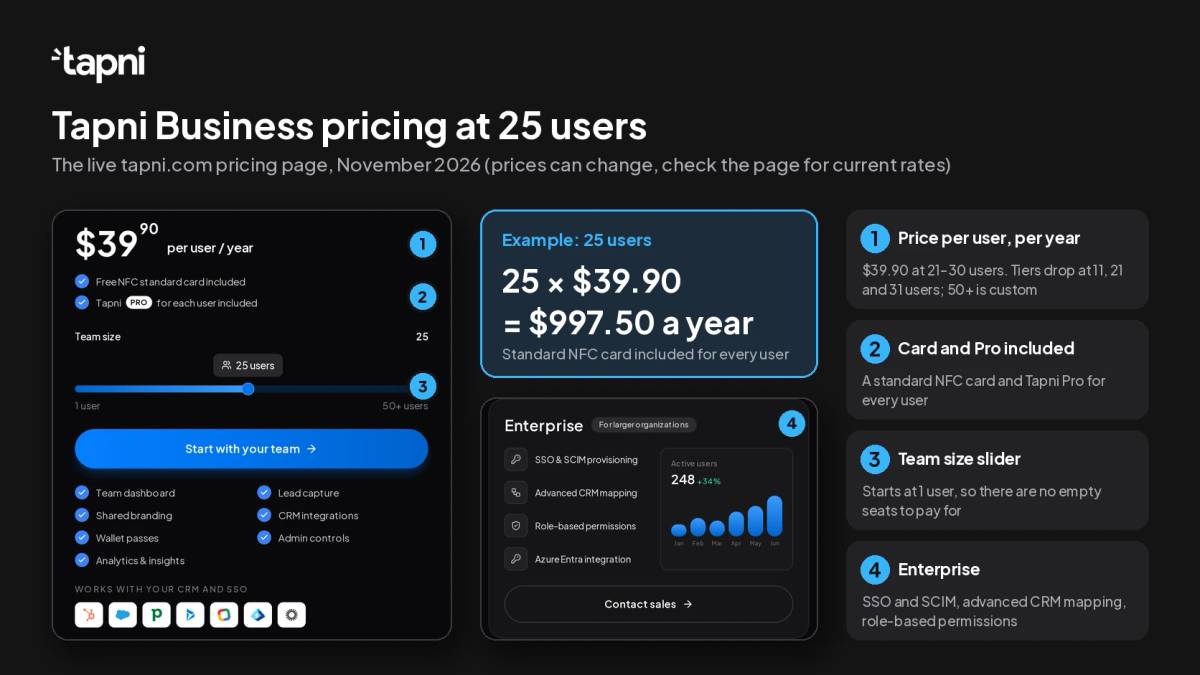
Two practical points for budgeting. First, the pricing slider starts at one user, so a small team doesn't have to pay for empty seats to meet a minimum. Second, the standard NFC card is part of the seat price, so you don't need a separate card budget for each user. If you want metal or bamboo cards for some or all of the team, ask for the upgrade price in your quote.
Hidden costs to check before you sign
The seat price is rarely the whole bill. These are the line items that most often change the total.
Physical NFC cards
Many teams still want something to hand over at a meeting. Check whether a physical card is included in the seat price, sold separately per card, or left to you to source and program. Ask what a replacement costs when a card is lost, and what happens to a card when someone leaves. For a team of 25, cards bought separately can add a noticeable amount to year one. Our article on whether NFC cards are more expensive than paper ones covers the longer-term maths of reprints versus reusable cards.
Lead capture, enrichment and per-lead fees
This is the line that varies most between vendors. Examples from pricing pages as of November 2026:
- Blinq lists $9.99 per lead captured and enriched under lead capture and enrichment on its Business plan, with bulk discounts available.
- Wave Connect charges for event lead capture in credits, at $2.50 per credit on pay as you go. A lead form, paper business card or LinkedIn scan uses one credit and an event badge uses four, and no credit is used if nothing is found. Purchased credits are valid for 12 months.
- HiHello Business includes 50 paper card or badge scans per user per month, pooled across the team, with contact enrichment on each scan.
To compare these fairly, estimate how many leads your team captures in a year (events, meetings, inbound) and multiply. A team that collects 1,500 enriched leads a year at $9.99 each would spend more on leads than on seats. If events are your main use case, our guide to lead retrieval apps explains what you need at the booth.
SSO, SCIM and IT requirements
If your IT team requires single sign-on or automatic user provisioning, find out which tier includes them before you compare prices. On the pages we checked, SAML SSO and SCIM provisioning sit in custom-priced enterprise tiers at Tapni, Blinq, HiHello and Wave Connect. HiHello's Business plan does include Google and Microsoft SSO with directory sync. Moving to an enterprise tier often changes the price per user, so ask for both quotes.
Minimum seats and how seats are counted
Minimums affect small teams most. Blinq Business starts at five cards, HiHello Business at five users and Wave Connect Teams at three users. Ask how seats are counted, whether you can remove seats mid-term, and whether added seats are charged pro rata. Blinq, for example, says cards added on its annual plan are charged pro rata to the end of the billing cycle.
Monthly vs annual billing
Monthly billing gives flexibility but costs more. On the team plans we checked, the monthly rate was 20–40% higher than the annual rate:
- Blinq Business: $4.99 per card per month billed annually, $6.99 billed monthly.
- HiHello Business: $5 per user per month billed yearly, $6 billed monthly.
- Wave Connect Teams: $5 per user per month billed annually, $7 billed monthly.
For a team of 25, the difference between $5 and $7 a month is $600 a year. If you are confident about the rollout, annual billing is usually the better deal. If not, run a short pilot first.
Setup, onboarding and admin time
The least visible cost is time: designing templates, importing the team, connecting the CRM and training people to actually use the cards. Ask whether onboarding support is included or charged, and whether you can import users in bulk. The guide to managing users in bulk shows how this works in Tapni. Our team rollout plan covers the project from kickoff to launch, so you can estimate the internal hours.
Total cost of ownership worksheet
Use this worksheet to compare quotes on the same basis. Fill in one column per vendor for year one, then repeat for year two, when one-off costs such as cards and setup usually fall away but new hires still need cards.
| Line item | How to calculate it | Example: Tapni Business, 25 users |
|---|---|---|
| Seats | Users × price per user per year at your tier (or monthly price × 12) | 25 × $39.90 = $997.50 |
| Minimum seat top-up | Seats you pay for but don't use to meet a minimum | $0 (no minimum shown) |
| Physical NFC cards | Users × card price, plus spares for new hires and losses | Standard card included per user |
| Card upgrades | Metal or bamboo cards for some or all users | Ask for quote if needed |
| Lead capture and enrichment | Expected leads per year × fee per lead or credits used | Lead capture listed in the plan |
| Premium features tier | Extra cost for SSO, SCIM or advanced CRM mapping if required | Enterprise plan, custom quote |
| Monthly billing premium | Difference between monthly and annual price × 12 × users | Priced per user per year |
| Setup and admin time | Internal hours × hourly cost for setup, imports, training | Free onboarding support included |
| Taxes and currency | VAT or sales tax, and exchange rate if billed in another currency | Check at checkout or in your quote |
| Total, year one | Sum of the lines above | $997.50 plus any upgrades, tax and internal time |
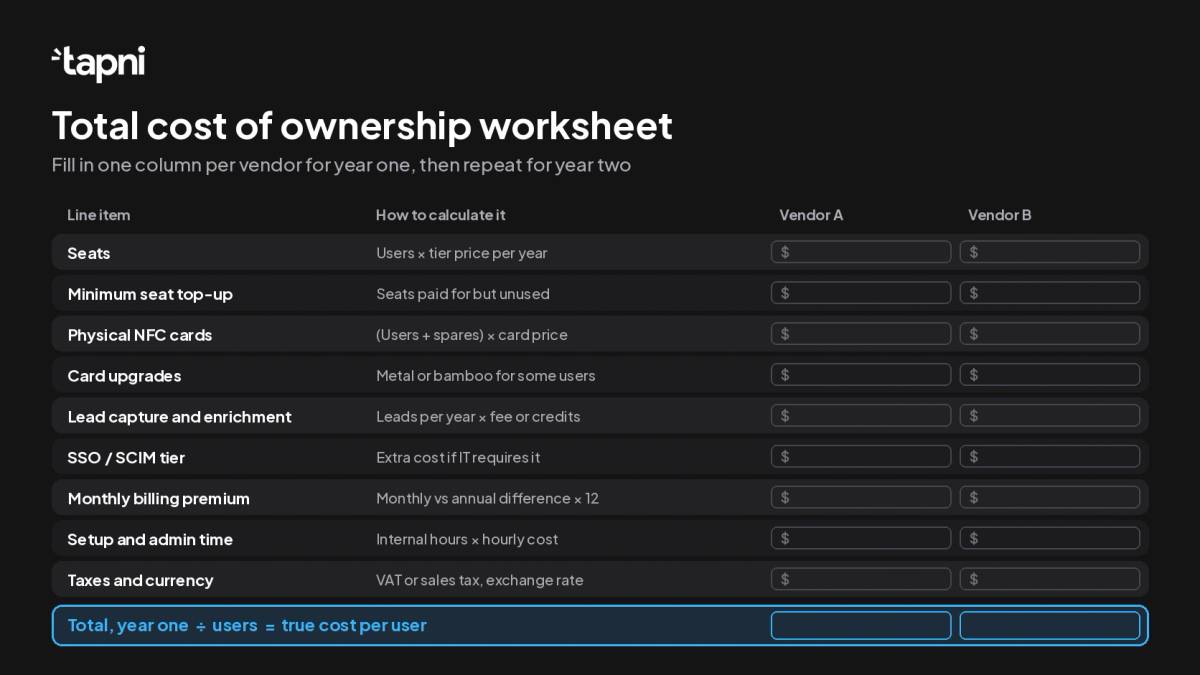
Once you have a total, divide it by the number of people on the plan to get a true cost per user. Then compare it with what the team spends today on printed business cards and reprints, and with the value of the leads that currently never reach the CRM. If CRM sync is part of the business case, our guide to digital business card CRM integration explains what to set up so captured leads are actually used.
How to budget for 2027 in five steps
- Count the people who need a card, not your total headcount. Sales, account management, leadership and event staff are the usual starting group. Add expected new hires for the year.
- Estimate lead volume. Count events, meetings and trade shows, and how many contacts each produces. This decides whether per-lead fees or credits matter for you.
- List your IT requirements. If SSO, SCIM or role-based permissions are must-haves, get enterprise quotes from the start.
- Request written quotes on the same basis: same team size, annual billing, cards included or priced separately, lead capture fees spelled out, taxes shown.
- Fill in the worksheet for years one and two, then pick the platform with the lowest true cost per user that meets your must-haves.
Once the team is live, track whether the cards are being used. In Tapni, you can see your most active employees and each person's profile views by NFC tap, QR scan and link, with date filters and CSV/XLSX/PDF export. That makes it easy to check, at renewal time, whether every seat is earning its place.
Questions to ask every vendor about pricing
- What is the price per user at our exact team size, and at which headcounts does it change?
- Is there a minimum number of seats, and how is a seat counted?
- Is a physical NFC card included per user? What do replacements and upgrades cost?
- Are lead capture, scanning and enrichment included, or charged per lead or per credit?
- Which tier includes SSO, SCIM and role-based permissions, and what does it cost?
- What is the difference between monthly and annual billing, and can we switch later?
- How are seats added or removed mid-term, and are they charged pro rata?
- Is onboarding support included?
- Are prices shown with or without VAT or sales tax?
FAQ
How much do digital business cards cost per employee?
Based on published team plan prices as of November 2026, most platforms cost between about $30 and $60 per user per year on annual billing, depending on team size. Physical NFC cards, lead enrichment and enterprise features can add to that. Large teams usually get a custom quote.
How much does Tapni Business cost?
As of November 2026, Tapni Business costs $59.90 per user per year for 1–10 users, $49.90 for 11–20 users, $39.90 for 21–30 users and $29.90 for 31–49 users. Teams of 50 or more get custom pricing. Every user gets a free standard NFC card and Tapni Pro. Current prices are always on the pricing page.
Is it cheaper to pay monthly or annually?
Annually, on every team plan we checked. Monthly rates were 20–40% higher than annual rates as of November 2026.
Are physical NFC cards included in the price?
It depends on the vendor. Tapni Business includes a free standard NFC card for every user. Other vendors sell cards separately or let you use your own, so add them to your worksheet.
Do we need NFC cards at all?
Not necessarily. Every digital business card can also be shared by QR code or link. Many teams still choose NFC cards because they are faster to share in person and give people something to hand over. For one-off needs such as a poster or a booth sign, a free QR code generator is enough.
Get a price for your team
The cheapest seat price isn't always the cheapest year. Compare vendors on total cost: seats at your real team size, cards, lead capture fees, the tier you need for IT, and the time it takes to roll out. To see Tapni Business with your own branding and get pricing for your team size, visit Tapni for Business or book a 30-minute demo with our team.


