Browse our comprehensive product guides and documentation



Summarize with AI








For startups, the remote work revolution that’s taken place within the last decade has been a godsend: no longer restricted to hiring in their local area (which can be costly and talent-pool-limiting), early-stage businesses can essentially hire anywhere, since all their new starters theoretically need is a stable internet connection to go with their job-specific skills and experience.
But while this shift to so-called “telecommuting” has largely been driven by advances in cloud-based technologies and software tools that facilitate virtual collaboration (video conferencing platforms, project management apps, and so on), it’s also somewhat thanks to the widening availability of EOR solutions tools that enable businesses to hire wherever they like without worrying about complex legal regulations.
If your startup is New York-based, for example, but you’re hoping to hire a marketing manager in Missouri, or a finance analyst in Florida, an employer of record provider acts as something of a “middleman” between your company and the employee (in essence, the EOR is the legal employer), taking care of any red tape associated with cross-state hiring so you can focus on getting the best out of your new talent.
Looking to hire a remote employee in another US state? Check out the best EOR platforms for startups hiring across the country.
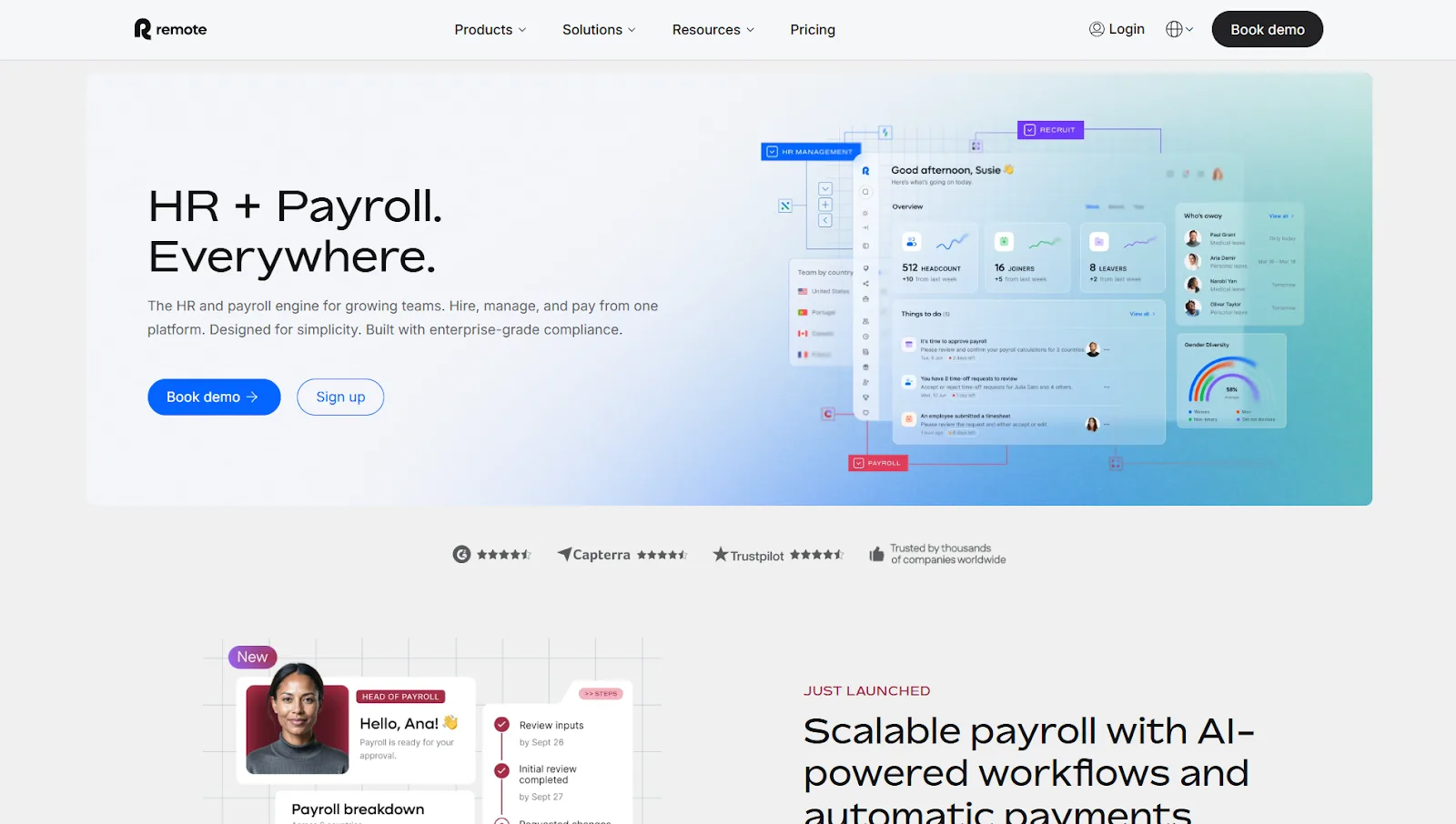
For business hiring across the US, Remote is one of the “big players” in the EOR game but in truth this platform is way more than just an employment middleman.
Sure, Remote allows you to hire in every US state in line with state-specific laws (as any reputable EOR should), but it’s truly an end-to-end remote hiring solution with an integrated job board that helps you source and attract talent from anywhere and onboard them seamlessly.
It’s also great if you’re just looking for short-term freelancers or consultants. Many startups don’t have the budget for full-time hires, and Remote’s contractor management platform enables you to draw up instant, legally-bound contracts and pay your contractors as soon as they submit their invoices.
It’s also refreshingly transparent when it comes to pricing. Some EOR providers are guilty of keeping certain costs hidden or suddenly hiking up their fees, but Remote’s fair price guarantee means you’ll always know exactly what you’re paying for and you’ll never pay a penny for a feature you don’t want or need.
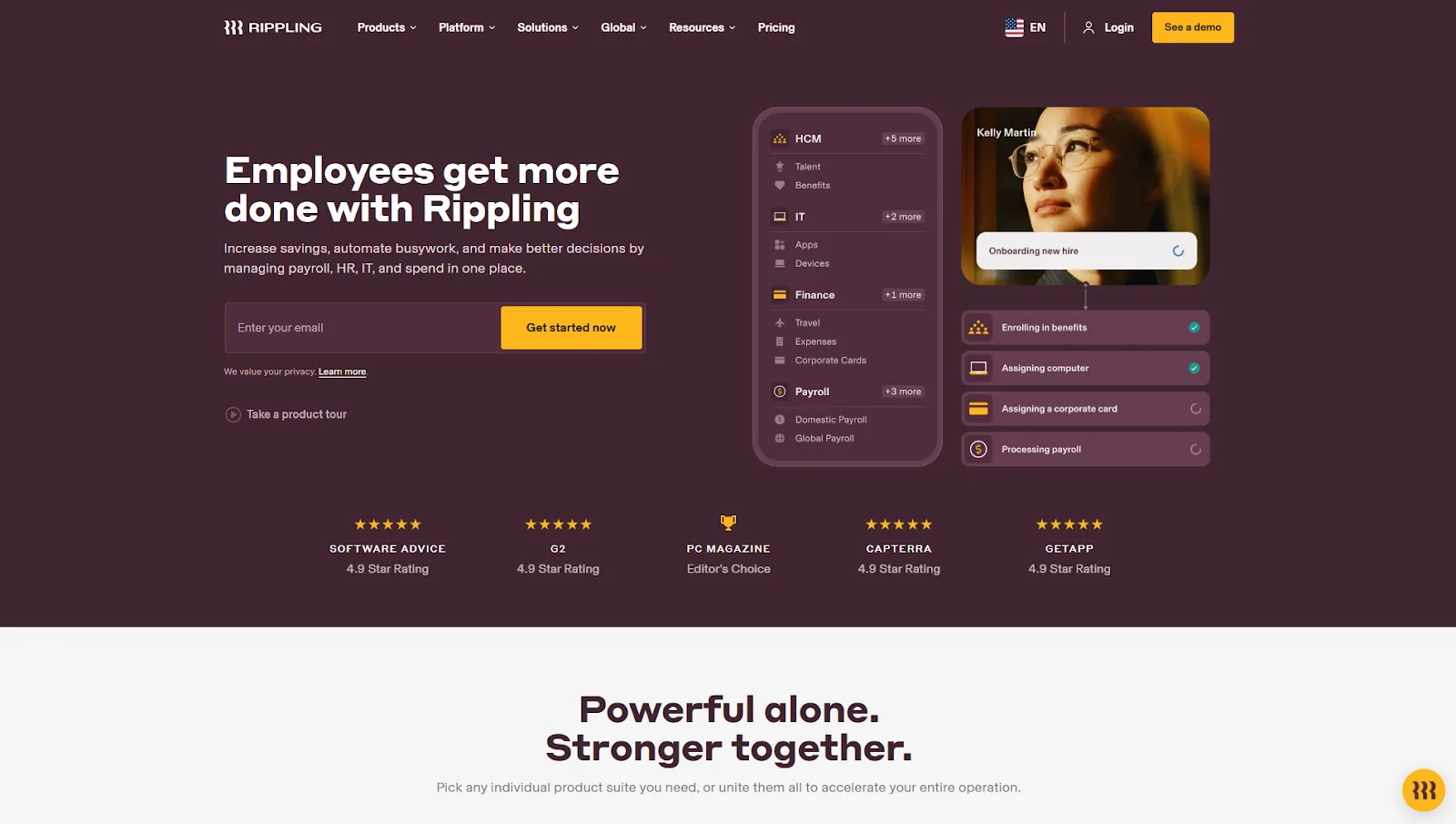
Rippling has become a favourite among scaling startups because it brings something many EOR tools lack: genuine operational unity. Rather than flipping between one tool for onboarding, another for payroll, another for device management, and another for HR data, Rippling consolidates all of this into one platform.
Its US-wide EOR capabilities are strong, enabling founders to compliantly hire in any state with payroll, tax registration, and benefits handled automatically.
Where Rippling particularly shines, however, is automation. Once you create a workflow, Rippling automatically triggers everything from sending offer letters, to provisioning a laptop, to enrolling the employee in relevant benefits. For lean teams with limited admin capacity, this is game-changing.
The only drawback? Rippling can feel like too much platform for very early-stage teams. Its breadth is impressive, but if you just want basic EOR support without broader HR or IT features, you may find the system slightly “heavier” than necessary.
Papaya Global positions itself as an infrastructure-focused platform, and that’s evident in the way it handles complex payroll workflows. For startups hiring across the US, it offers compliant onboarding, payroll, benefits, and time-off administration all supported by a centralised dashboard that makes multi-state hiring far less intimidating.
One standout is Papaya’s payroll intelligence layer, which gives finance teams real visibility into workforce spend. This is particularly useful for founders trying to forecast burn rate or explain payroll changes to investors. Its contractor management is also strong, making it easy for startups to mix full-time employees and freelancers within the same system.
Some users note that Papaya’s interface is slightly more data-dense than other EOR tools, however. It’s powerful, but teams wanting a more minimalist, consumer-style UI may need a short learning curve before they feel fully comfortable.
Remote People has rapidly emerged as a strong choice for startups looking for a transparent, flexible, and cost-efficient EOR partner in the United States. Known for its straightforward pricing starting at just $199 per employee per month it’s particularly attractive for early-stage founders managing tight budgets.
What makes Remote People especially compelling is its reputation for reliability. According to independent EOR comparator RemotePad, Remote People is ranked among the leading EOR companies in the USA, reinforcing its credibility and growing global presence. For US hiring specifically, the platform offers clear compliance guidance, simple onboarding flows, and consistent support across all states, making it easy for founders with no HR background to stay compliant.
Remote People’s focus on transparency also stands out in a market where hidden fees are common. Startups hiring across multiple states will find its predictable cost model reassuring, ensuring they scale operations without unexpected EOR expenses.
Justworks is often described as one of the most straightforward platforms for US-based companies that want to hire across different states. As a PEO with EOR-style capabilities (through Justworks EOR), it simplifies payroll, benefits, compliance, and HR tasks so early-stage companies can offload the administrative burden of managing a team.
Its interface is clean and friendly, and founders often praise how easy it is to run payroll, manage PTO, and onboard new employees. Access to high-quality health insurance plans is another major plus, especially for startups that want competitive benefits without negotiating with carriers on their own.
The trade-off is that Justworks is not a pure EOR in the traditional sense; its PEO and EOR models operate separately. Some startups may need to evaluate which route actually fits their hiring plans, which can add a layer of decision-making early on.
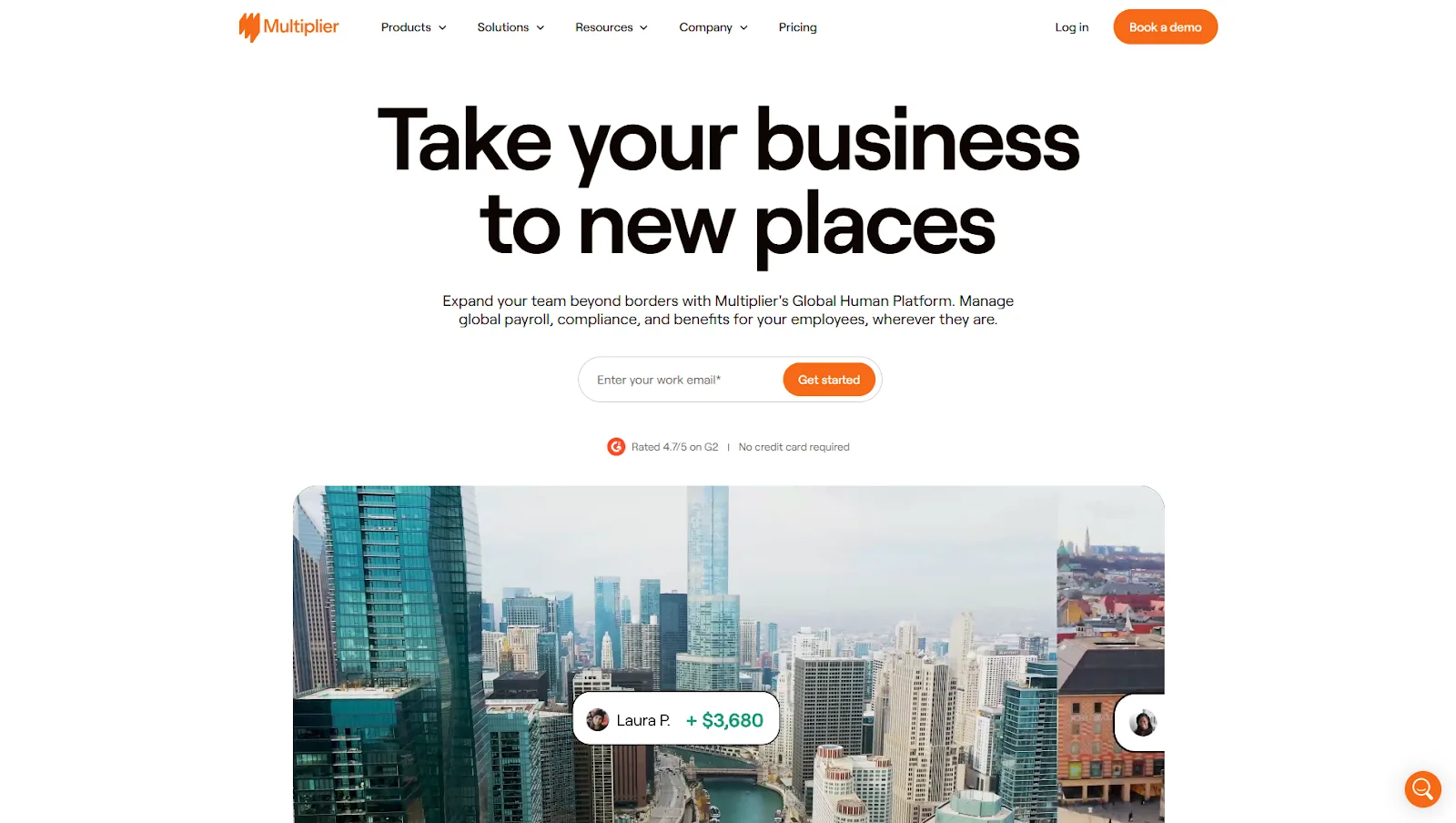
Multiplier offers a smooth, modern platform with strong compliance insights and clear onboarding processes for employees based anywhere in the US. Startups will appreciate its structured hiring workflows, which walk you step-by-step through what’s required for each state, reducing uncertainty around factors like tax and benefits contributions.
Its standout feature is its unified employment contract generation, which automatically adapts contracts to align with local employment rules. This gives founders peace of mind when hiring in states with stricter regulations, making it a strong fit for companies with teams distributed across multiple locations.
If there’s one consideration, it’s that Multiplier’s marketplace of integrations isn’t as deep as some long-established competitors. Everything essential is there, but teams with highly customised HR stacks may have to check compatibility carefully.
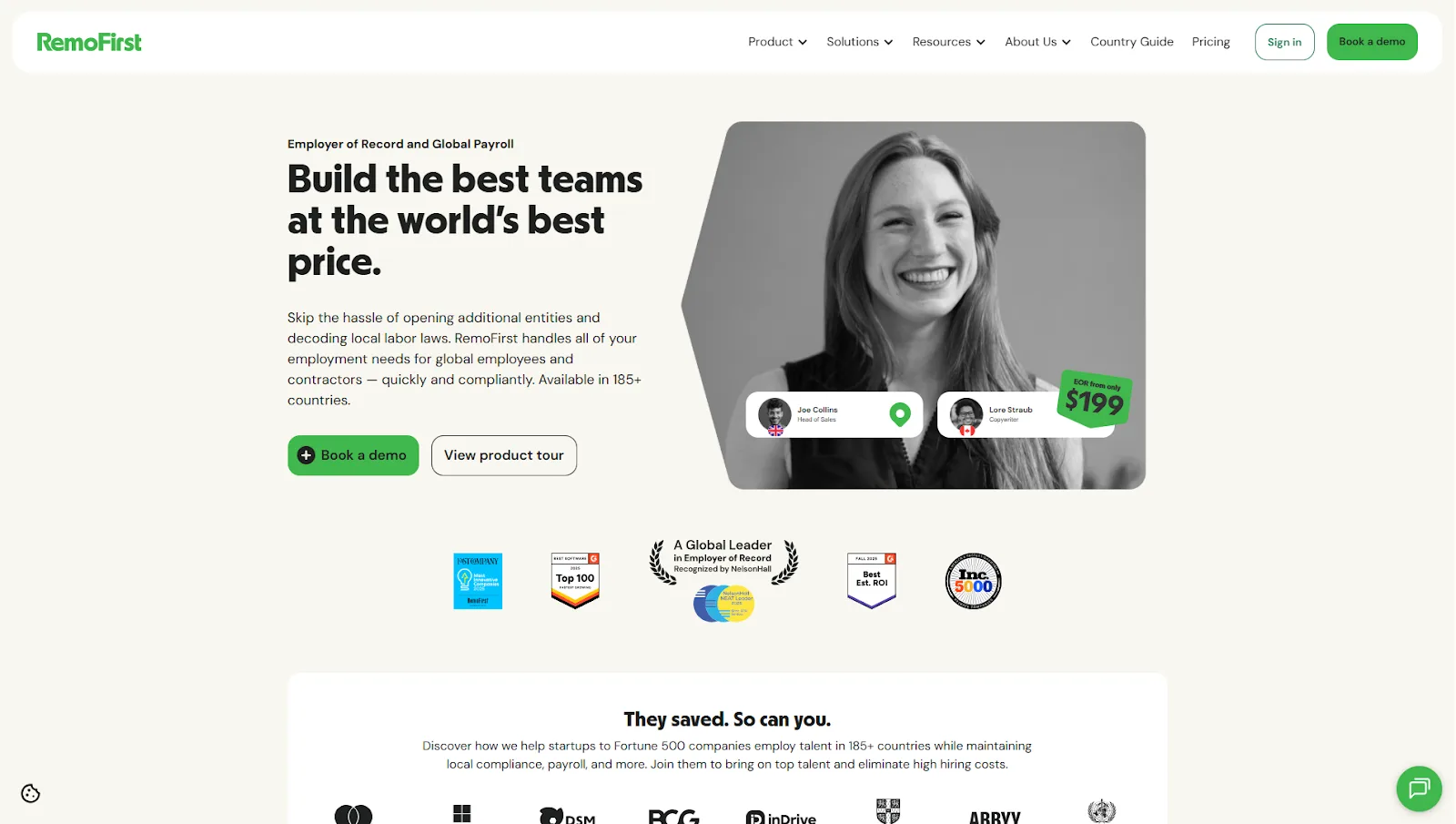
Remofirst has gained traction among budget-conscious startups because it offers core EOR capabilities at competitive pricing while still delivering the compliance support essential for interstate hiring. It handles onboarding, payroll, time-off tracking, benefits administration, and contractor management all in a clean and easy-to-navigate interface.
Startups like Remofirst because it removes the “noise”. Instead of overwhelming you with dozens of extra HR features, it focuses on getting employment right: correct tax setup, timely payroll, compliant documentation, and accessible support. This makes it a solid choice for small teams hiring their first remote employees across the country.
The limitation? It’s more streamlined than feature-heavy. For teams expecting deep reporting or advanced analytics, Remofirst may feel decidedly lighter compared to some of the bigger enterprise-oriented platforms.
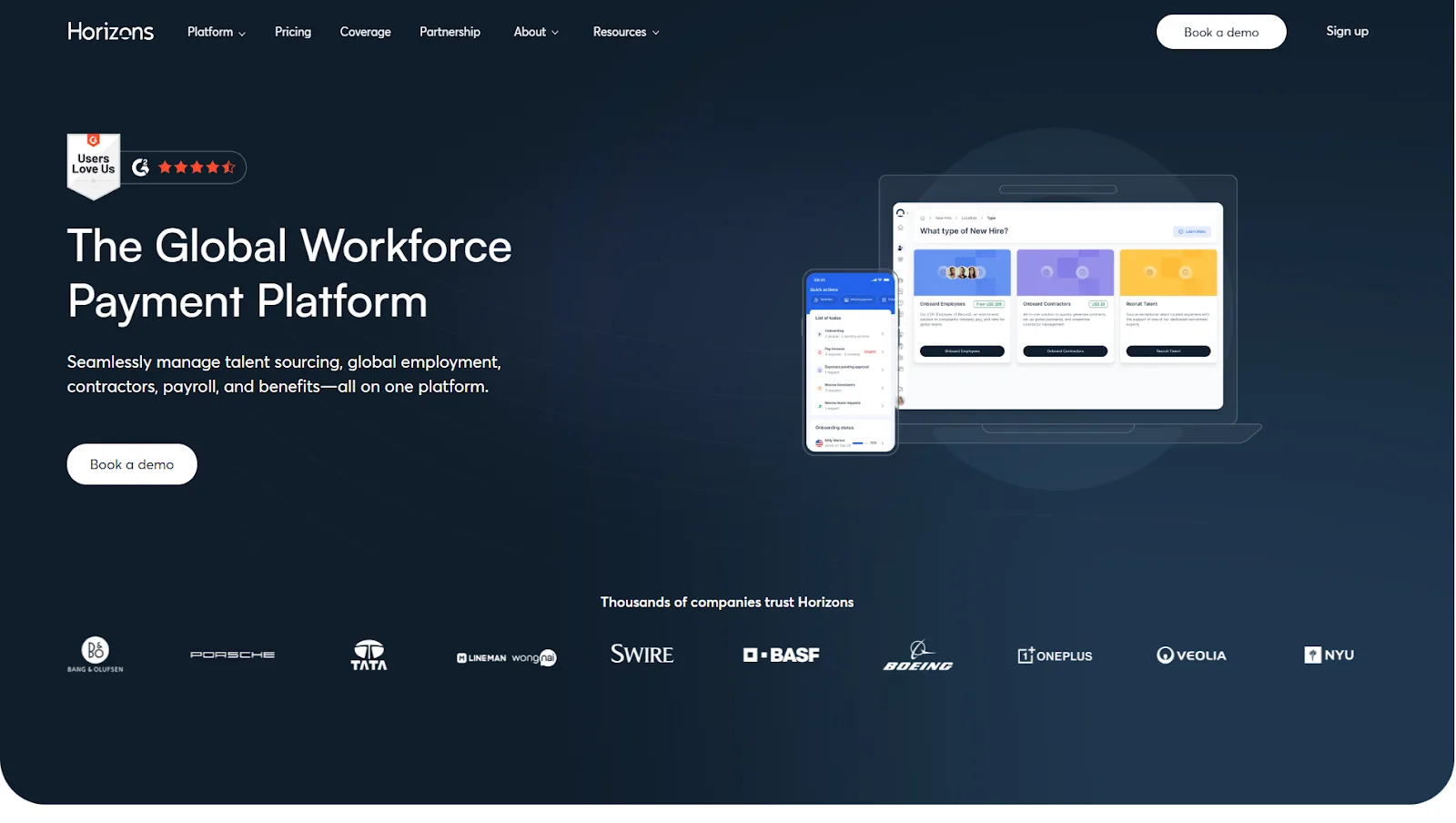
Horizons is an EOR platform that stands out for its consultative approach. Rather than just providing software, the Horizons team helps founders understand the legal and operational implications of hiring in different US states. This can be incredibly helpful for teams without internal HR or legal expertise.
The platform manages payroll, onboarding, benefits, and compliance, and its documentation makes state-by-state employment differences easier to grasp. It also offers strong support for hybrid teams mixing contractors and employees, which is especially common among early-stage startups.
One minor drawback is that Horizons is generally known for its global EOR offerings and market entry consulting, so the US-specific platform, while fully functional, may not feel quite as feature-rich as competitors that specialise heavily in US hiring.
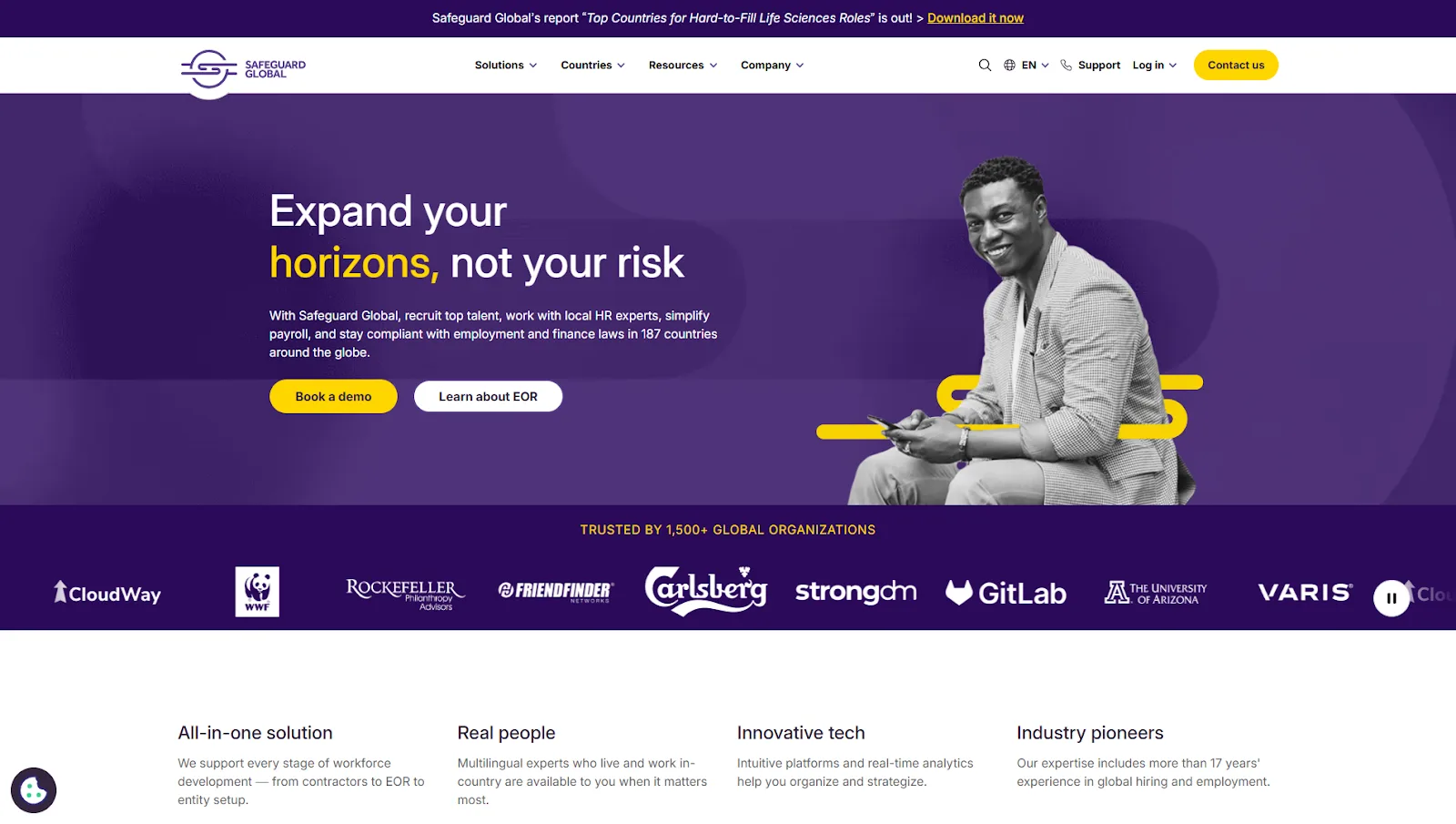
Safeguard Global has long been recognised for its depth in workforce compliance, payroll infrastructure, and employment risk management making it ideal for startups that want a dependable EOR partner as they scale across states. Its platform brings together onboarding, payroll, benefits, and ongoing employee support under one umbrella.
A key strength of Safeguard is its emphasis on workforce strategy. It offers insights into labour costs, compliance updates, and hiring trends, helping founders make more informed decisions about where and how to expand their team. Its support teams are also experienced with complex organisational setups, which is a plus for fast-growing startups.
The trade-off is that Safeguard Global can feel oriented toward mid-market or enterprise clients. Smaller startups may find its platform more robust than they strictly need, but this does also mean it can scale with you as you grow.
Oyster has become a well-known global hiring platform that supports compliant hiring across the United States and beyond, making it ideal for startups that want one system for both domestic and international talent. Its clear documentation and detailed hiring guidelines make it a solid option for founders who don’t have an HR background.
The platform focuses heavily on risk reduction, offering helpful compliance alerts and local hiring guidance so you always know what you can and cannot offer in each state. Oyster also shines when it comes to employee experience; its onboarding flows are polished, informative, and designed to make new hires feel looked after from day one.
The minor limitation is that Oyster leans slightly more global than US-specific. Everything works perfectly well for US hiring, but the deepest product innovation is oriented towards cross-border compliance rather than purely interstate hiring.
Once you’ve chosen an EOR platform and successfully hired talent across different states, the next challenge is helping your distributed team show up professionally in front of clients and partners.
This is where tools like Tapni come in. With Tapni’s digital business cards and smart profiles, every new hire whether they’re in New York, Florida, or Missouri can instantly share their contact details, role, and social links with a single tap.
For startups that operate 100% remotely, Tapni helps create a consistent, on-brand identity across the whole team, making it easier to build trust with customers, investors, and partners, no matter where your people are based.
For US-based startups embracing remote hiring, an EOR platform is a strategic enabler of growth. The right provider removes compliance headaches and lets you build a distributed team with confidence. Whether you prioritise automation or affordability, there’s an EOR solution here that can help you scale across all 50 states without slowing down.